Saturday, May 18, 2013

Technology and the Expert Translator


In what follows, translating refers to written translation. Interpreting is another story.

Once upon a time, Expert Translators only needed two pieces of technology. One was the time-honoured paper dictionary, and the other was a typewriter (preferably an IBM Selectric with its interchangeable print balls). Indeed, in the 1970s and 1980s I visited several countries where even Professional Translators were still writing out their translations in longhand. Perhaps the first really useful modern technological novelty was the photocopier.

Then came computers.

First came word processors. In the beginning only for English, but then extending (and still extending) to other languages. In the 80s I came across an Arabic processor (very clunky) for the first time in Amman, and an Inuktituk one in Canada. In the following decade, the world of communications was transformed by the internet.

The above, however, were universal tools that translators used along with other writers and office workers. How about more dedicated tools designed specifically for translators? The first breakthrough was the computer-stored multilingual term banks; in Canada and Europe from about 1970 onwards. Computer stored but still very labour intensive. The second wave was that of translation memories using bitext (see Terms below), which were invented at the end of the 1980s. Then people got the idea of linking them along with the above-mentioned universal tools into what we called translator workstations.
  
More recently, the workstation components have been fully integrated and marketed as computer-assisted translation (CAT) software suites. The best known of them is Trados (www.trados.com). It includes terminology management, translation memory building and other functions. Many employers now require their staff translators and freelance contractors to know how to use it.

Translation memory is also changing bilingual lexicography. Linguee (www.linguee.com) is now the dictionary I most often turn to, and it‘s based on translation memory. Also it’s a dictionary that requires the judgement of an Expert or Advanced Native Translator.

For me, the turning point had come already in 1976. It was in that year that we introduced a Computers and Translation course into the undergraduate translation programme at the University of Ottawa. A Canadian first. My colleagues agreed to it only on condition that it be an optional course. But by 1980, at the request of the students themselves, it became compulsory.

Nowadays conferences and seminars on translation technology have become all the rage in translation studies. It’s impossible to keep up with the innovations and assess them all. That‘s why Jost Zetzsche‘s Tool Box Newsletter (see References) is so useful. He wrote recently,
“Someone asked me last week: Do you still always come up with enough material for your newsletter? The answer is I don't have to: the material comes to me. If there was enough to cover in translation technology 219 editions ago, there is certainly more than enough today.”
All this is leading up to the following:
One of the distinguishing characteristics of the Expert Translator is knowledge of the technological tools available and how to use some of the most advanced ones. The Natural Translator doesn’t need them and may not even be aware they exist. The Advanced Native Translator is likely to have become acquainted with the most basic ones.
Notice that for once I'm saying something prescriptive; the reality is that Expert Translators, even Professional ones, often fall short of the ideal, especially the older ones.
  
Terms
  • Bitext: a computer-stored source text and its translation keyed to one another in such a way that retrieving a segment in either of them automatically retrieves also the corresponding segment in the other.
  • Translation memory: a collection of bitexts, typically compiled by computer. Some of them are augmented on the fly as the translator works.

References
  • Jost Zetzsche. The Tool Box Newsletter. Blog. The Basic Edition is free on the internet. The Premium Edition costs $25 a year. Website here. Jost is co-author of Found in Translation, reviewed a few weeks ago on this blog. To find the review, enter jost in the Search box on the right.
  • Brian Harris. Bi-text [sic], a new concept in translation theory. Language Monthly (Nottingham, UK) no. 54, pages 8-10, 1988. Language Monthly has long since ceased publication, but there are copies of it in the British Library and the Library of Congress.

Image
96-character interchangeable type balls for IBM Selectric typewriters. Source: Wikimedia Commons.

Sunday, May 12, 2013

Literary Native Translators


Translated by Joan Pinkham

Julie McDonough Dolmaya teaches translating and translation studies at university level in Toronto. She has a blog, which has recently been mostly about her teaching innovations. This week, however, there’s something different: an obituary of a distinguished American literary translator, Joan Pinkham.

Joan was best known internationally as the English translator for the French historian Henri Troyat, but in Canada for her translation of Les Nègres Blance d’Amérique (The White Niggers of America) by Quebec nationalist writer Pierre Vallières. What makes the obituary outstanding is that Julie had the good fortune to be able to interview her towards the end of her life, and the interview, which Julie transcribes for us, is full of glimpses into the joys and tribulations of a literary Professional Translator. Anyway, read it all here on Julie’s blog.

I draw attention to it on this blog for one particular passage in the interview. It’s where Joan states categorically,
“As a translator, I am basically self-taught [my emphasis]. At the time I was in school, there were no official academic programmes in translation in the U.S. (or none that I was aware of). Courses at the British Institute in Paris and at Middlebury College in Vermont — they were called “Stylistics” – were invaluable but insufficient for my purposes. So I studied on my own, reading such books as I could find, preparing translations of Maupassant and comparing mine to the many different printed versions, learning much from the bilingual documents that constantly came across my desk at UN.”
This means that she started out as a Native Translator, albeit an Advanced Native Translator. (For more on these terms, enter essential definitions in the Search box.) She became an Expert Translator by working at it on her own and by the publication of her books. (The Literary Translators’ Association of Canada accepts one published book as a sufficient qualification for admission.) Hers was the typical developmental profile of literary translators. Like all bilinguals, they can already translate. They hone their craft by reading and by practising their writing skills, not by going to school. If they have academic qualifications, those are usually in literature.


Saturday, May 4, 2013

YI Guidance Pack


The Hampshire Young Interpreter Scheme (YI) has been featured in several recent posts on this blog. I’ve praised it as significant for bilingual education, but don’t just take my word for it: it won a European Award for Languages in 2010 and was a finalist for the MJ Local Government Achievement Awards in 2012. Ofsted, the official body for inspecting UK schools, has declared that
“Those pupils who act as young interpreters make an outstanding contribution of enabling those pupils speaking little English and their parents or carers to take full part in all school activities.“
Now the YI Guidance Pack for teachers has reached me in Valencia.

The Pack is a well-organised, stimulating and suggestive aid for teachers in schools that have a considerable proportion of immigrant students speaking languages other than the dominant language of the country. It's attractively designed and illustrated. It comes with a DVD that contains some good videos. Pupils also have access to Moodle, a free e-learning internet software platform.

Interpreting is treated as a serious practical activity, not as a game or pastime. The mode of interpreting is dialogue interpreting in a community interpreting setting. Here’s what the Pack has to say about preparation:
  • You should prepare by finding out what the meeting is about by talking to the person leading the interview.
  • You should also research some words that may be of use.
  • You should ensure that the location is private and rearrange the seats so everyone is equal.
  • You should introduce all parties.  
Good advice for adult interpreters too.
  
And here are some of the "golden rules" in the Interpreting Check-List:
  • Put all the information across.
  •  Keep neutral and avoid taking sides, avoid giving your opinion.
  •  Listen and show attention, stay focused, stick to the point.
  •  Respect cultural issues.
  •  Be patient, be polite.
  •  Know your boundaries.
The Guidance deals with a point that troubles some people when they hear about such young people interpreting, that of their having access to confidential information. It says,
“They should consider [the need for] confidentiality, but point out that as students they should not be asked to interpret in situations where confidentiality might be an issue.”
 Be it noted that confidentiality is among the rules of interpreting that are mentioned by students themselves.
  
How about recruitment and selection? Most of the pupils considered are already fluently bilingual or multilingual and have previously been ‘new arrivals’ themselves; and all must be “good role models in terms of their use of English,” which I take to mean that they speak something close to ‘standard’ English’ as taught in schools. But there is provision too for second-language learners “nominated by the Modern Foreign Languages departments in secondary schools.” In addition, they should demonstrate “a good knowledge of school routines, systems and activities,“ which takes care of some of the extra-linguistic needs. For the rest, the qualities sought are personality ones: “patient, good listeners, good communicators, responsible, etc.”  What is not tested or questioned is their ability to translate. It is assumed that they have it intuitively as bilinguals, and also that it will improve with some training. Both assumptions accord with the Natural Translation Hypothesis (click here for more.)

As one would expect from experienced teachers, there are lots of Role Play Scenarios, Interpreting Scenarios, Resource Sheets and the like. There are sections on selecting pupils to participate, on organising the training sessions and on what can be expected from ‘graduates’.
  
The DVD videos include a tribute from a head teacher and advice from a professional interpreter, an example of good interpreting by a student and also one of bad interpreting by an adult. This last is hilarious. It’s in the folder of Good and bad interpreting situations.
  
If you’d like to get hold of the Pack, go to the website http://www3.hants.gov.uk/education/ema/ema-resource.htm, then to the tab Downloads and Packs, and there you’ll find a link to an order form. The price is 38 pounds including postage and tax.

Image
Source: Shirley Community Nursery & Primary School, Cambridge, UK

Saturday, April 27, 2013

How Native and Expert Interpreters Can Work Together


Both Professional Expert Translators and Non-professional Native Translators have their place; work can be divided appropriately between them and they can be coordinated advantageously. This is neatly illustrated by a report that’s just come in from Canada. It’s about preparations for the International Children’s Games, but in this case the translators aren’t children.

Throughout the text, translator is used for interpreter, a common usage among lay people, even newspaper reporters.
“As Windsor and Essex County [an area on the Canada-USA border opposite Detroit] get ready to welcome the world on Aug. 14, there is still a lot of work to be done. A big part of that is recruiting and training volunteers to make sure the International Children's Games run smoothly. That job is about to get a bit easier, thanks to a $56,000 Trillium Foundation grant which will be used by the Multicultural Council to recruit a translation team of 250 members.
"‘Our community is making every effort to expand on the concept of translation ambassadors by ensuring each of our delegations will have a translator at these games,’ said Nora Romero, host committee member and sponsorship chair. ‘The grant will allow us to identify, recruit and train volunteers.’
“Romero said the funding will be used in three different ways. First, there will be certified translators [i.e., Professional Experts] whose job will be to work with the athletes and the media for interviews. Second, translators will be available to work with students in the various residences. And third, the translation team will be able to provide directions and guidance to friends and families of the athletes.
"This will be a great opportunity for some of our new Canadians [the Canadian euphemism for immigrants] to volunteer and get involved in the Games,’ she said.”
By the time they get to the Games, all the volunteers will be Native Translators from the training they’re to receive. It won’t be advanced training. I know because I took part in a similar interpreter training programme for the Inter-American Games in Winnipeg in 1997, when 3,000 local Spanish speakers applied for 30 places in the programme. But training over 200 of them in a few months is quite an achievement and it couldn’t be done if they weren't at least Natural Translators to start with.

References
  • Kelly Steele. Trillium funds translators for Children's Games. The Windsor Star, April 22, 2013. The report is here.
  • For the terms Native Translator, etc., enter essential definitions in the Search box on the right.

Sunday, April 21, 2013

Young Interpreters Update


YI Conference 2012

For more about Young Interpreters (YI), see the posts of March 8, 14, 19, 24 and 31.


Now the latest issue of Young Interpreters Newsletter gives some updated figures. The number of known YI has risen from 169 to 225, with more still to be identified, and the number of languages from 36 to 39.

Since reading the above, the thought has obsessed me that the YI scheme has a significance beyond mere numbers. It marks a milestone in the recognition of Natural and Native Translation, namely the point at which translation has entered general basic education. Previous reports started with individual child translators. Then groups of school-age interpreters formed at isolated schools; several have been mentioned in this blog. The Canadian group called The Ambassadors described in 1993 and inspired by the earlier work of Mary Meyers in Toronto (see References) was perhaps the first organised, teacher-supervised body of schoolchildren interpreters reported, but still in a single school.

Now the YI scheme is spreading throughout a whole national school system, though there is still a lot of ground to prospect. And its emphasis is as much on what interpreting can do for developing the interpreters as on what they can do for others. For it to flourish, an approach to education is required that encourages activities over passive learning. (I’ve heard this mentioned as one of the differences between British and Spanish schools.) I’ve long thought that fluent bilinguals should be taught translating from a young age, the younger the better. This is the antithesis of the commonly held view that translation is a university-level subject, but then it doesn’t aim at the same kind of translating and it’s not held out as professional. Translating at school raises linguistic awareness and gives practice at a valuable skill, rather in the same way as singing in the school choir raises musical awareness and trains to produce music. Of course, as with any natural ability, there will always be an elite who are exceptionally good at it on the one had, and on the other hand a few unfortunates who have to live with an impediment; just as the school choir will reveal those who are potential opera singers and those who are tone deaf. But generally speaking, translating is beneficial for all fluently bilingual children and not only those who are exceptionally gifted. And bilingual children are too commonplace for them to be considered exceptionally gifted just because they speak two languages.

References
Image
Source: Fairfieldsnews blog, 2012.

Saturday, April 13, 2013

Medical Language Brokering: A Testimonial


Let me make it clear from the start that I share the concerns of Professional Expert medical interpreters and many other people about letting immigrant children translate between family members and health care staff. The litany of objections includes the following:
  • The possibility of dangerous mistranslations, omissions and additions, especially in a field that uses a lot of technical terms
  • Placing on children a responsibility for which they are too young
  • Putting the children under stress from their relations with their family members and with the medical staff in addition to the difficulties of the translating itself
  • Exposing children to situations, knowledge, private and intimate data that it’s inappropriate for them to be acquainted with at their age.

An additional concern   rarely mentioned but one that I’m conscious of myself as a translator for a professional college of physicians and surgeons: the vulnerability of the interpretations and the interpreters to challenge in the event of litigation.
  
Nevertheless, this blog aims to describe things as they are and not as they ought to be; to use the terminology of linguistics, it’s descriptive and not prescriptive. And the reality is that a great deal of ad hoc medical interpreting for immigrants is still done by their children. The following recollection helps to explain why, as well as describing the experience from a child’s viewpoint. The author was brought up in California and is now in her early twenties.
"California lawmakers are currently [2005] considering legislation that would prevent children from providing language interpretation at hospitals, doctor’s offices and clinics. This made me think back to all the times I translated for my mother at the doctor’s office or hospital.

"I disagree with this law because a lot of the time the only accessible interpreter is a patient’s child. The proposal says that hospitals may have to provide their own translators, but due to the estimated $15 million price tag, many health experts say the state may fall short in trying to provide translation service. Some have even warned that doctors may turn away immigrant patients if they are forced to provide translators.
"In the case of my mother and her doctor’s appointments, if I had not been there my mom would not have had anyone to translate for her. Professional interpreters are expensive and a lot of times, my mother was expected to be able to provide her own translator when it came to understanding documents or speaking with someone about medical business.
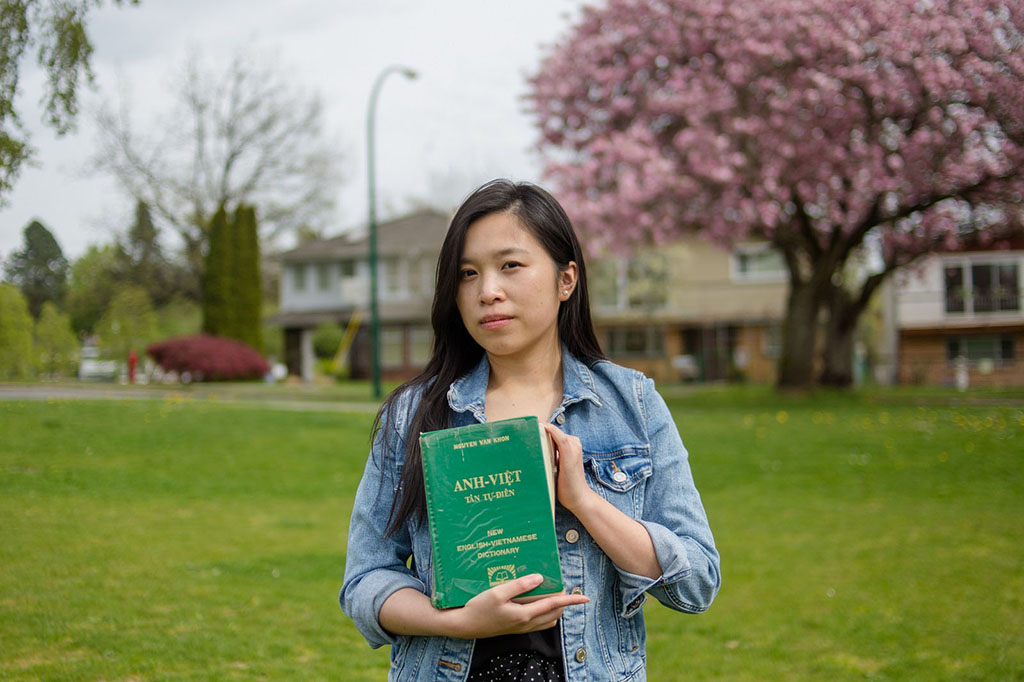
"I come from a family of Vietnamese immigrants. I am the first generation from my mother’s side to be born here. Even when I was a small child, my mother assumed that I knew all the English there is to know. My mother figures that language is language; you just need to know basics. She was wrong.
"From fourth grade on, I have been my mother’s translator. Whenever she had an appointment with a doctor, I came along to help her with translating. When it came to just naming body parts and symptoms, I was usually good at that, but there were a lot of terms that I did not understand in either Vietnamese or English.
"I learned a lot of things during those visits. I learned as a fourth grader that women have eggs inside of them. I learned that many conditions have the same symptoms, so that regardless of the illness, a patient, like my mother, would often repeat words such as hurt, nausea, and dizziness.
"That was when the doctor would have to explain his side of the conversation. He would tell me what the issue was in English, and I would try my best to regurgitate the explanation in Vietnamese.
"There was often trouble when I had to translate the documents that my mom brought home from her doctor. There were times when even a Viet-English Dictionary did not help me because the terms in the documents were too technical to be found in my dictionary. I felt bad about not being able to decipher the words, but I just went ahead and helplessly extrapolated what I could. I didn’t know what else to do.
"I would feel bad because I knew my mother came to me only because she needed me and couldn’t afford a professional interpreter. We come from a low-income family and money is hard to come by. Therefore, it was made clear to me that going to an American school even if it was an elementary school qualified me for the job of being the go-between for my mom and the outside world.
"This job wasn’t always easy, but it was an important part of family life in my immigrant family. Banning this interaction between child and parent especially when the family has no other choice  seems wrong to me. When I was interpreting for my family, I felt I was fulfilling my filial duty. I was contributing to the family.
"I hope that the state could get to a point where every non-English speaking person can have access to a professional translator when they need one as they seek health care. If that happened, children like me wouldn’t have to learn a third language  medical talk  that they may or may not fully understand. But until California feels it can definitely give us the translators we need, sons and daughters should not be barred from helping their parents in times of need."
Considered together with the immediately preceding posts on school interpreters and the other mentions of child interpreters in this blog, the above is one more pointer to the universality of translating by children. There seems to be no restriction on place or language, and nor is it limited to exceptionally gifted children.

It also provides a little insight into how this language broker translates. This is an aspect that's not well covered in the literature on language brokering, where ability to translate is generally accepted as an a priori. Here we may note two techniques. One is that the Vietnamese girl used a dictionary, even if not always successfully. Ability to use dictionaries is not something that comes naturally; she must have learnt it somehow, and it immediately classes her as a Native rather than a fully Natural translator. (For these terms, enter essential definitions in the Search box.) The other is extrapolating, something that even Expert Interpreters have recourse to when they can't hear or can't understand the speaker. In the jargon of the trade, it's called winging it. It may perhaps be intuitive.

Reference
Thuy Ngo. Translation Trouble — Children May Be Barred from Interpreting for Parents. Youth Commentary, 2005. Posted by imd in Asian inShare, October 20, 2012. The full article is here.

Saturday, April 6, 2013

2nd International Conference on Non-professional Interpreting and Translation (NPIT2)


The Arms of Germersheim
So the Call for Papers for NPIT2 is out. And this time it will be held at a hallowed site of translation studies, the Germersheim campus of the University of Mainz, Germany, from May 29 to 31 next year. The deadline for submissions is October 31, 2013. Germersheim is near Heidelberg. You can get to the website by clicking here.

NPIT1 was held at Forlí, Italy, last year. You can read about it by entering forli in the Search box on the right. I’m glad to see that Rachele Antonini, who was the inspirer and principal organiser of NPIT1, is on the Advisory Committee for NPIT2. With NPIT2, I dare hope to think that the penetration by this sector of translating into academic translatology is confirmed, although it’s still only a beachhead. Better late than never. As the Call so rightly says,
“Within the field of interpreting and translation studies, non-professional interpreting and translation has always been under-appreciated, neglected and under-researched by academia… Nonetheless, it remains and will continue to be the most widespread form of translational activity.”
The Call reiterates a distinction that will be familiar to Followers of this blog, namely that Professional Translator and Expert Translator, though commonly linked concepts, are not the same thing.
“Such a [non-professional] action occurs when an individual translates or interprets without receiving pay. ‘Non-professional’, however, does not mean that the translation/interpreting is of insufficient quality or that the skills of a non-professional translator/interpreter are inadequate.”
In other words, to use the terminology of this blog, a person may be an Expert Translator without necessarily being a Professional Translator. (For more about these terms, enter essential definitions in the Search box.)

Other topics of this blog are covered in the list of topics in the Call.